INTRODUCTION: THE QUEST FOR SCHEDULED TRIBE STATUS AND ITS IMPACT ON ETHNIC RELATIONS IN MANIPUR
The violence witnessed in Manipur, where the Meitei community is demanding the Scheduled Tribe (ST), goes on to highlight the connection between ethnic identity, politics, and the economy in this region. Meiteis form around fifty-three percent of the population of the State of Manipur and form a sizeable majority in there. But the fact that they have not been given the ST status has led to much resentment and feeling of injustice among the Naga and Kuki communities, which constitute nearly 40% of the population (Bag, 2023). Following the Indian government’s decision concerning the demand for Kuki’s ST status, more than one hundred people were killed and more than 50000 were displaced (The Hindu, 2023). The demand for ST is based on issues of resource ownership, affirmative action, and political representation. The Northeastern region has a rich tapestry of ethnic and cultural identities that are often at odds with each other. Meitei community inhabiting the Imphal Valley has better education and health facilities as compared to the Naga and Kuki inhabiting poverty stricken areas (Singh, 2022).
The situation escalated as the violence persisted and could still be justified through the majority-minority struggle with regards to power through the lens of politics. On this note, the Indian Express has observed that the increasing quota for ST status has worried the Naga and Kuki groups about the violation of peace in the region. A survey conducted in 2022 described that close to 70% of Kuki respondents felt intimidated by the possibility of giving ST status to the Meitei and this indicates a worrying factor in terms of relations between communities.
Restoring peace in Manipur requires innovative economic policies focusing on dialogue, fair resource allocation, and conflict resolution. Such economic inequalities and lack of comprehensive identity formation need to be overcome and instead a broad, comprehensive approach needs to be developed to ensure better integration to all areas of the Manipur state, which in turn would ensure better overall and sustainable peace in Manipur.
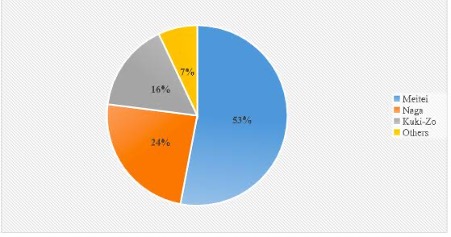
Source : The Indian Census (2011)
PROPERTY RIGHTS AND LAND CONFLICTS : A CHALLENGE FOR STABILITY IN MANIPUR
In Manipur, tribal land ownership has become a heated topic, aggravating disputes amongst different ethnic groups. Additionally, the Scheduled Tribe (ST) demand made by the Meitei section of society aims to control the land resources considering its agricultural viability. The Manipur Land Revenue and Land Reforms Act of 1960 clearly states that tribal lands are to be preserved, however expansion into new territories and the sales of those lands tend to create disputes. With 60 percent of Manipur’s economy reliant on agriculture, land disputes erode both productivity and long-term economic stability. To add to the crisis, reports indicated that since May 2023, over 50,000 tribal people have been uprooted from their homes increasing the feelings of insecurity prevailing in the communities, as the demand for ST status also rose (The Hindu, 2023). The income generated from land is heavily embedded in the heritage and culture of the people. If Manipur is to create an economically peaceful environment, strong public policies designed to allocate land fairly and to diffusing tensions so as to permanently resolve the root issues has to be developed. Enabling the government to resolve conflict and create more space for development, tribal land rights would be active in being served.
ESCALATING VIOLENCE AND HUMANITARIAN CRISIS IN MANIPUR : A CALL FOR URGENT ACTION
The persistent violence in Manipur has slowly turned into a humanitarian issue as it moderately suggests that systematic violence is being orchestrated against the Kuki and Naga tribal communities. Human Rights Watch reported that as of May 2023, approximately 100 people had been killed, and thousands are still being displaced because of the conflicts that arise due to the demand for ST status for the Meitei community. The destruction of housing and community assets reduced capital stock, deepening insecurity and economic disruption. Over 50,000 people have been displaced and are currently residing in relief camps as of October 2023 making the situation require urgent humanitarian purposes. Furthermore, the Gross Community Product GCP in various estimation suggest that over 15000 houses were torched or damaged during the civil unrest making the economic situation tougher.
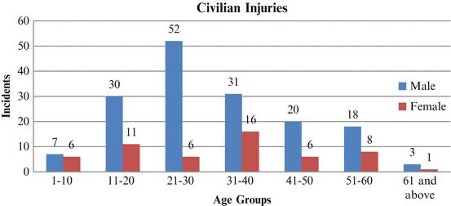
Source: The Hindu
There has been engagement on this issue particularly in relation to unrest in different parts of the world. In the same realm, we have talked of the local governments having either adequate or inadequate responses to human rights crises. In this particular case, Human Rights Watch has chronicled examples of the force’s negligence in protecting certain members of society: for example, moving into an area of conflict too late or ‘politically’ sensibly siding with certain factions. Negligence sustains impunity, raising the economic cost of conflict by discouraging investment and recovery. In addition, these issues mentioned are not coupled with effective mechanisms for the resolution of conflict and community protection policies, which makes the communities feel neglected. The combination of the scope of violence and the failure of the government to take necessary measures speaks of a dire need for political reforms. Advocating for accountability, security, and dialogue among people from all ethnic backgrounds would help achieve peace and solve the causes of the cycle of violence in Manipur.
| Ethnic Group | Deaths | Injuries | People Displaced | Houses Burned | Religious Sites Vandalised |
| Meitei | 67 | 1008 | 30,000 | 1,700 | 66 (temples) |
| Kuki-Zo | 98 | 383 | 41,500 | 2,600 | 254 (churches) |
| Naga | 20 | 50 | 2,000 | 300 | 40 (churches) |
| Meitei Pangal | 10 | 20 | 500 | 186 | 26 (mosques) |
| TOTAL | 195 | 1,461 | 74,000 | 4,786 | 386 |
Table 1: Destruction in Manipur
Sources: The Hindu, Indian Express, The Guardian, The Diplomat
CRITICAL ASSESSMENT OF EXISTING POLICIES AND THE NEED FOR REFORM IN MANIPUR
The recent unrest in Manipur points to serious gaps in the current policy framework and governance structures, thus suggesting the urgent need to rethink the strategies. The lack of enforcement and protection of such communities in the course of the deepening humanitarian crisis exhibits a gross negligence that aggravates violence. Respecting the Peace Economics that states that economic development and growth is only possible in a stable and cohesive society, the unrest affects the growth of local markets and the region in general. The loss of 15,000 houses and displacement of 50,000 people lowered labor productivity and entrenched poverty traps. The policies in place should be reoriented focusing more on accountability mechanisms and engagement of various ethnic groups in constructive dialogue. The government should, though, target these root causes and develop better means of managing conflicts to create an environment conducive to peace and development. The need to carry out radical changes that enhance the prospect of conflict resolution by introducing economic benefits of peace in Manipur is dire for peace and development in the region in the long term perspective.
POLICY RECOMMENDATIONS: PATHWAY TO PEACE AND ECONOMIC STRATEGIES FOR A STABLE MANIPUR
Post-conflict Manipur needs immediate economic strategies to restore markets and secure long-term stability. In this light, the concept of federalism is crucial where local economic problems will be catered by the local governance. Decentralization expands representation, enabling marginalized groups like the Kuki and Naga to influence local economic allocation. A Peace and Conflict Studies research conducted in 2022 suggests that decentralization has a positive correlation with reduced intensity of violence in multi-ethnic societies since it provides a basis for economic solutions to the underlying issues A Peace and Conflict Studies research conducted in 2022 suggests that decentralization has a positive correlation with reduced intensity of violence in multi-ethnic societies since it provides a basis for economic solutions to the underlying issues.
Economic, social and political stability are largely interconnected where Manipur stands with many challenges and conflicts. As such, investment in efficient governance and institutional reform are crucial for ensuring peace. The principle aims that all people have the same opportunities and pay attention to equally ignored groups in society. With the ‘Kukis’ narrative in mind again with ‘Naga’ economic transformation policies can be formulated through decentralization. It is essential to concentrate on community-level development programmes as they deliver positive effects in areas with violence. Besides, policymakers should also consider community development programs to fall under education, healthcare, and infrastructure, which in today’s world are among the most pressing issues and therefore should take priority in getting addressed.
Community development investment is crucial in promoting stability. Issues such as education, health care and infrastructure should be put at the forefront by policymakers as they are critical components of economic growth. The 2023 Economic Survey shows higher human development reduces economic volatility and conflict intensity. Thus, increasing the availability of education and proper healthcare will provide people with tools for decent jobs decreasing the inequalities that cause problems over economic means. Importantly, microfinance and vocational training initiatives, can also enhance the earning potential of disadvantaged and displaced people especially in a sustainable way. These programs help people set up their own businesses, which promotes self-employment and self-dependence on jobs. Financing and training SMEs fosters local entrepreneurship, strengthening community-based economic integration.
Most importantly, conflict management and peacebuilding concepts may be included in an economics curriculum as an additional factor to promote peace. Economic practices in educational programs that involve working together and inter-ethnic dialogue will prepare future generations for peace making activities and working together. The establishment of a commission that seeks to address historical economic injustices that pertain to resource distribution is also vital. Such commission has the power to facilitate healing across communities. Additionally, improving the training of law enforcement in the prevention of economic crime will help instill confidence in multi-ethnic populations regarding their scope for economic endeavors.
In order to reduce resource based conflict, the issue of access to land and resources must be addressed through policy interventions. In this way, competition for economic resources will not result in conflict. A further, and perhaps very useful, step that can be taken is to establish economic groups that will cross-fertilize among different tribes and regions. This will help open the local economy and establish a sense of brotherhood. These groups function as hubs of cooperative investment, generating shared growth instead of competitive exclusion.
CONCLUSION
Looking ahead, peace in Manipur depends on economic strategies that rebuild trust, expand opportunity, and reduce resource-driven conflict. Immediate economic policies are crucial to reestablish markets and secure stability. In this light, decentralization becomes critical: expanding representation allows marginalized groups like the Kuki and Naga to participate in local economic decisions, reducing the intensity of violence. Economic, social, and political stability are interconnected, where investment in governance and institutional reform is vital for peace. In following these integrated economic policies, Manipur Peace shall ultimately be able to resolve the major triggers to the conflict, improve integration levels within society and assist progress towards achieving actualized development goals. This is as well consistent with what the country seeks to achieve, and the ongoing pursuit of, global peace, via SDG 16.
REFERENCES
Brauer, Jurgen, and William G. Gissy. The economics of conflict and peace. Taylor & Francis, 2017.
Chaturvedi, Soumya. “Calibrating the Peace building Process: A Case Study of Manipur.” FOCUS: SECURITY PARADIGM IN SOUTH ASIA.
Garfinkel, Michelle R., and Stergios Skaperdas. The Oxford handbook of the economics of peace and conflict. Oxford University Press, 2012.
Keynes, John Maynard. The economic consequences of the peace. Routledge, 2017.
Rahman, Jiyaur, and Zeba Sheereen. “Economic implications of intra-state conflict: Evidence from Manipur state of India.” (2012).
Singh, Amom Malemnganba. “Meitei Majoritarian Politics of the BJP in Manipur.” Economic and Political Weekly 58, no. 1 (2023): 10-12.
(2023). Unfolding the Manipur Riots. Economic and Political Weekly
(2023). Violence over ST Status. Economic and Political Weekly
https://www.thehindu.com/news/national/kukis-fight-for-land-and-identity/article66980855.ece
https://www.ohchr.org/en/press-releases/2023/09/india-un-experts-alarmed-continuing-abuses-manipur
 Ghettu's Blog